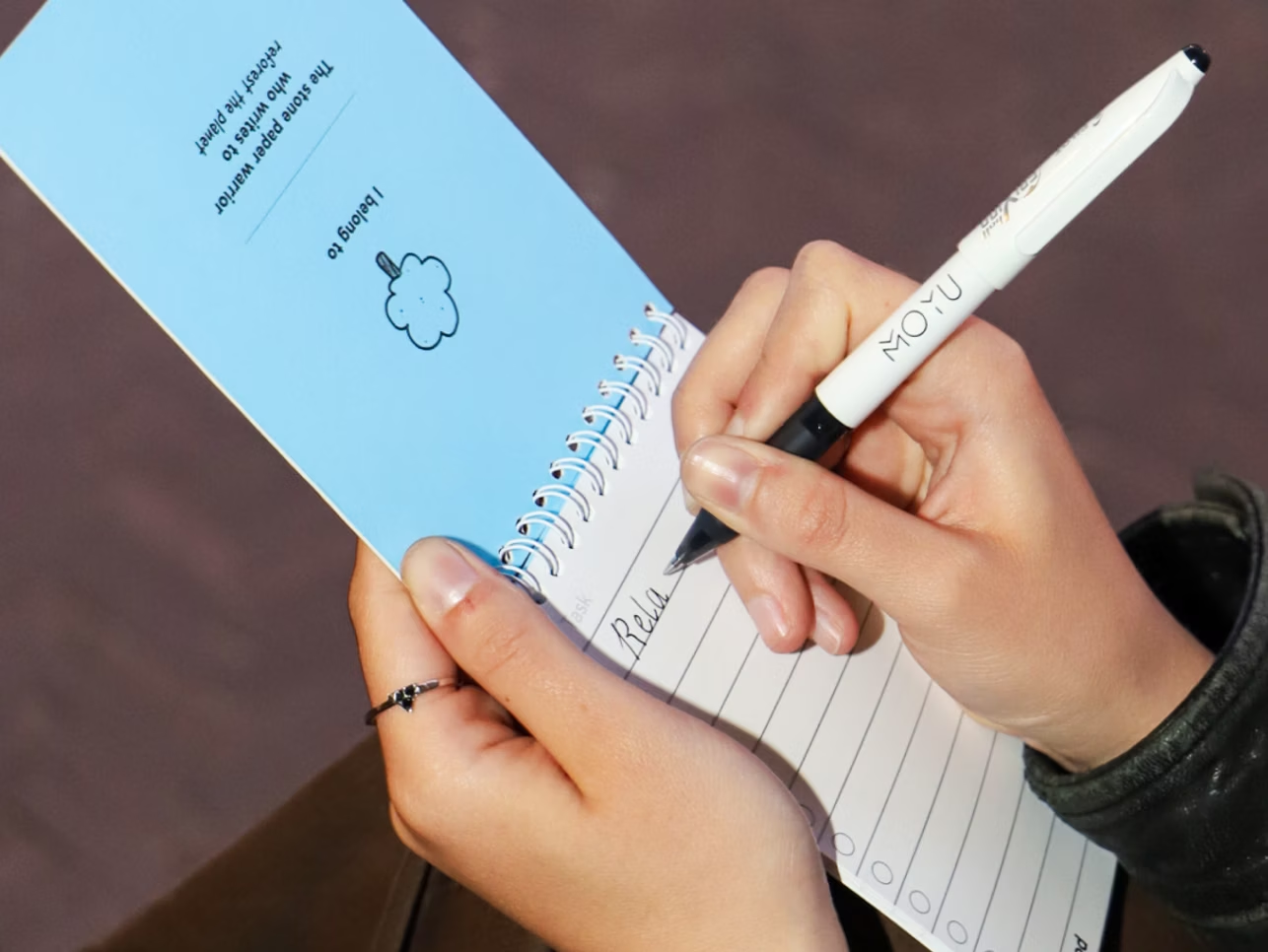
A question we often get from students: can I take my lecture notes in a reusable notebook? The short answer is yes, for most university work it works fine, but there is an important caveat: a reusable notebook erases your notes, so for material you want to keep until exam time you need a digitization system. In this article we explain how that works, for which courses it does or does not fit, and how students at universities including Wageningen University & Research use it in practice.
We are the makers of MOYU, reusable stone paper notebooks. So we have a stake in convincing you. But we also see students who try our product and conclude it does not suit them. That is fine. This article is here to help you choose, not to push you over the line.
First the numbers: how much paper does a student actually use?
According to figures published by Saxion University of Applied Sciences, an average student uses around 22 kg of paper per year. Roughly a 10 cm stack of loose sheets, notebooks and printed slides. About 30% of all print jobs at an educational institution are never even picked up from the printer.
One reusable MOYU notebook replaces about 15 paper notebooks over its 3-5 year lifespan. Independent LCA (ISO 14040/14044): 0.37 kg CO2 per MOYU notebook, versus 6.00 kg for the paper equivalent. That is 94% less emissions. Not decisive for your study results, but relevant if you also want to study sustainably.
For which type of coursework does it work well
Practical classes and exercises
During a workshop you often need to try, cross out, try again. With a reusable notebook you can work without the hassle of pages full of failed calculations. Statistics, mathematics, programming exercises, chemistry reactions, anything where you experiment with answers.
Brain dumps and first-draft notes
During a lecture you often write down much more than you need later. A reusable notebook is perfect for the rough first version. You write everything, go through your notes at home, make a consolidated summary in another system (a notebook you keep, OneNote, Notion), erase the raw material.
To-do lists and weekly planning
What do I have this week for which course, which deadlines are coming, which papers do I still need to read. Classic reusable use case.
Short summaries for exams
For an exam you often create a summary of the material. A reusable notebook works well here: you rewrite and erase until you have a good summary, photograph the end result with your phone for your study archive, and reuse the page for the next exam.
For which type of coursework does it work less well
Material you want to keep throughout your studies
Will you still read your lecture notes back in three years for your master thesis? Then you have to either scan them or keep them in a regular notebook. The whole point of reusable is that you erase. For material you need later, a paper notebook or a good scan workflow is required.
Courses with many diagrams, formulas or figures
For figures you later need to explain to yourself it works less well, because the figures are gone once you erase. Or you have to scan them every time before erasing, which is extra steps.
Group work where you share notes
Notes that physically circulate between people do not work well in a reusable book. For group work, digital (Google Docs, OneNote) or shared paper is more logical.
Courses where you work with markers
We only work with erasable pens (MOYU pen, Pilot FriXion). Highlighters and thick markers do not work or stain. For people who organize notes in color, a regular notebook or one with thicker paper is more practical.
How students actually use it: a few workflows
Workflow 1: The minimalist
A student buys one MOYU A5 for all courses, with half the pages lined and the other half dotted. For every lecture he writes the notes, goes through them at home, types a summary in Notion or OneNote, erases the page, ready for next week.
Advantage: one book for everything, no piles of notebooks. Disadvantage: requires discipline to digitize weekly.
Workflow 2: The scan workflow
A student uses MOYU for brain dumps and first-draft notes, and scans every page before erasing via a phone scan app (Apple Notes, Microsoft Lens, CamScanner, Google Drive scan). Result: a digital archive plus a physical book that lasts the whole degree.
Advantage: nothing gets lost. Disadvantage: 10 seconds scanning per page, you have to build that into a habit.
Workflow 3: The combo
Some students use MOYU alongside a traditional paper notebook. The reusable book for brain dumps, experimental work and exercises, the paper notebook for clean, consolidated notes they keep. If your studies involve a lot of practice work (STEM, language grammar), this combination often pays off.
What we saw at Wageningen University & Research
In 2021, Green Office Wageningen, the sustainability bureau of Wageningen University & Research, made a video about MOYU as a sustainable writing solution. Students there have used MOYU for coursework, exercises and brainstorming sessions. The video is publicly viewable on YouTube: https://www.youtube.com/watch?v=r6N2vHzYzKE.
What they reported back was mainly that it suits studies with a lot of practice calculations, first drafts and rewriting work. For a WUR student working with experimental schemas, ecological models or statistical calculations, the ability to erase is functionally valuable.
Comparison: paper notebook vs reusable notebook for students
Aspect
Paper notebook
MOYU reusable
Price per year
Around €15–30 (multiple notebooks)
One-time €19.95–29.95
Lifespan
1–2 semesters per book
3–5 years
Keeping notes
Direct (paper)
Via scan app
Experimental notes
Lots of crossing out
Erase and redo
Works with markers
Yes
No
Works with fountain pen
Yes
No
CO2 equivalent per year
Around 2 kg
Around 0.12 kg
Fits in student bag
Variable
Compact (A6 or A5)
For which studies does it work best?
Based on what we hear back from students, MOYU works particularly well for:
STEM studies (math, physics, chemistry, biology) with lots of practice work and experimental calculations.
Programming studies where you sketch a lot of test code before implementing.
Language studies for setting up vocabulary systems and practice translations.
Studies with lots of brainstorming work (creative studies, communications, marketing).
Research masters or PhD where you work out lots of raw ideas before publication.
Less suitable for:
Studies where you use a lot of markers and color coding.
Clinical studies where reports must be kept permanently.
Studies where group notes are physically shared.
Frequently asked questions
Which MOYU size is best for students?
A5 (148 x 210 mm) is the most used size for students: large enough for lecture notes, small enough to fit in a laptop bag. A4 is used for students with lots of diagrams or large formula work. A6 is for pocket use (quick to-dos, not for long notes).
How do I digitize my lecture notes before erasing?
Open a scan app on your phone (Apple Notes scan feature, Microsoft Lens, CamScanner, Google Drive scan), hold your phone above the page, app automatically makes a straight scan. Save in a folder per course. Time per page: about 10 seconds.
Does MOYU work for drawing diagrams or graphs?
Yes, with the erasable pen you can make diagrams, graphs and figures fine. Keep in mind that if you erase, you have to redraw the figure. For figures you need later, scan before erasing.
Is MOYU suitable to take to an exam?
For an exam itself you usually use the paper documents the university provides. MOYU is for your preparation, your summaries and your daily notes, not for writing the exam itself.
What if I accidentally erase notes before scanning them?
Then they are gone. This is the main trade-off of a reusable notebook: anything not digitized before erasing is lost. Build scan-before-wipe as a habit. End of a block, a week or a chapter: scan and erase. Not the other way around.
Do I get a student discount at MOYU?
We do not have a standing student discount program on the general shop. For schools and educational institutions ordering in larger quantities (from 25 units) there are volume prices via our B2B team.
An honest conclusion
A reusable notebook is not a one-size-fits-all solution for every student. It works best when you build a workflow where scan-before-erase becomes a habit, and if your studies involve a lot of practice work and brain dumps. For students who want to keep everything permanent and work with markers, a paper notebook remains the logical choice.
What a reusable notebook does solve: stacks of battered exercise books at the end of the semester, and the pile of paper every student produces in 5 years of studies. For those who adapt their workflow to it, in the long run it is often cheaper and always more sustainable.