"Paper is recycled at over 80% in the Netherlands, so why would I need an alternative?" I hear this a lot, and it is a fair question. We are, after all, the European champions of paper recycling. But that number does not mean what most people think it means. So let us look at the actual data: what really happens to paper after the papiercontainer, how often it can loop, what recycling costs in water and energy, and how a stone paper notebook honestly compares, plastic included.
Our ambition: zero waste, no asterisk
Let me start with where we want to go, because it frames everything else.
Stone paper is, in theory, endlessly reusable as a material. Our factory is Cradle to Cradle certified and produces without waste water and without production waste. The minerals do not degrade the way paper fibres do. Theoretically, every MOYU could become a new MOYU.
In practice, there is one missing piece: volume. A dedicated stone paper recycling stream does not exist yet, simply because there is not enough stone paper in circulation to make one economically viable. That is not an excuse, it is a to-do list. We are setting up return logistics ourselves so that no MOYU ever needs to become waste. More on that below.
But first, the paper industry. Because the story you have been told about paper recycling deserves a closer look, even here in the land of the papiercontainer and the oud-papier-actie of the local football club.
What the Dutch paper recycling numbers really say
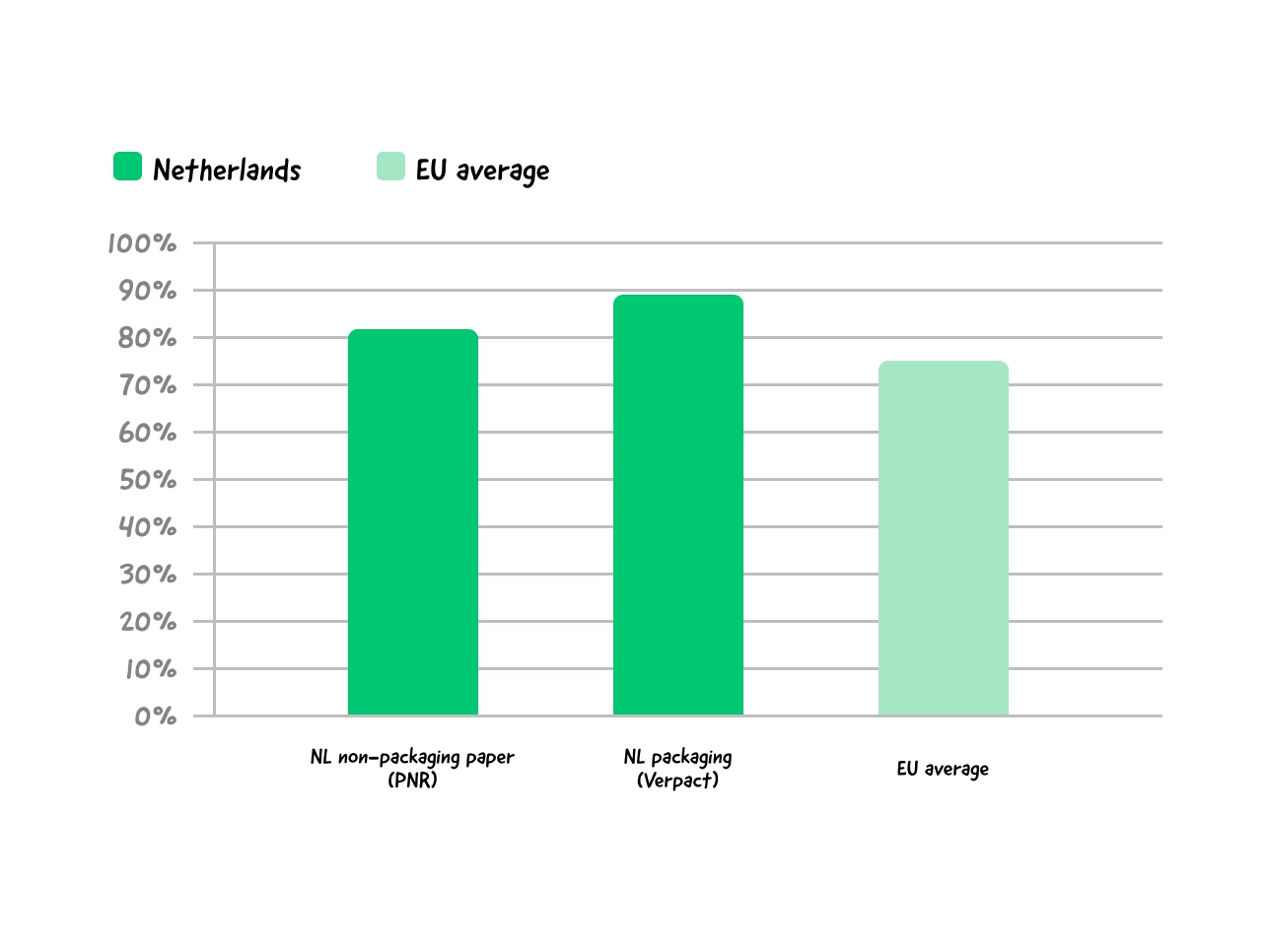
The Netherlands is genuinely the best in class. In 2024, 81% of non-packaging paper and cardboard (think notebooks, magazines, printing paper) was collected and recycled according to PRN, and 89% of paper packaging according to Verpact. The European average was 75.1% [1][2]. Something to be proud of, built on 150 years of collection culture.
And yet. Here is what sits underneath even the best numbers in the world.
The rate measures collection, not rebirth. These percentages count paper that is collected and delivered to a mill. The European definition behind them is the utilisation of paper for recycling plus net trade, divided by paper consumption [3]. It does not tell you how much actually becomes new paper. Part of Dutch oud papier is processed abroad, mainly in Germany and Eastern Europe, with the transport emissions and reduced traceability that come with it [4].
Even champions have a soft denominator. Cepi, the European paper industry association, notes that its record 2023 rate of 79.3% was partly explained by unusually low paper consumption that year [3]. Less paper consumed, same collection, higher percentage. No extra sheet was recycled. Any collection-based rate, Dutch ones included, moves with the market this way.
Fibre is lost at the mill. Paper that reaches a recycling mill does not fully return. European mill research shows that the yield of recycled paper production can be as low as 75%, meaning up to a quarter of the collected paper ends up as sludge, which is largely landfilled or incinerated [5].
And fibre wears out. Here the gap between claim and measurement gets interesting. PRN states that paper can be recycled up to 25 times [1]. That figure comes from a laboratory study under ideal conditions [6]. Cepi's measured reality: in Europe, a fibre completes on average 4 recycling loops before it is too degraded to use [7]. After that, it leaves the system for good. Tissue and hygiene paper leave the loop immediately and cannot be recycled at all [2].
Recycling paper also costs resources. Recycling is clearly better than making virgin paper. Research commissioned by the German Federal Environment Agency found that recycled paper production saves 78% water, 68% energy and 15% CO2 compared to the usual mix of virgin papers [8]. But "less" is not "none". Repulping, deinking and drying still consume significant water and energy, and generate that sludge stream. Recycling is damage reduction, not damage removal.
Add it up and the honest Dutch picture is this: roughly four fifths of our paper is collected, the best score in Europe. Then up to a quarter of that is lost at the mill, part is processed abroad, and what survives loops about four times before leaving the system forever. World class? Yes. The closed circle from the marketing brochures? Not even here.
Now let's hold stone paper to the same standard
Fair is fair. If I put the paper industry under the microscope, our stone paper notebooks go under it too.
Stone paper consists of roughly 80% calcium carbonate (stone powder, largely from waste streams of the marble and limestone industry) and 20% HDPE, a widely used plastic that acts as the binder [9].
Yes, plastic. Let's not dance around it. Let's quantify it instead.
An A5 MOYU notebook weighs about 250 grams. At 20% HDPE, that is 50 grams of plastic. According to the UK Environment Agency's life cycle assessment of carrier bags, a standard HDPE shopping bag weighs about 8 grams [10]. So one notebook holds the plastic of roughly 6 shopping bags.
Now add the time dimension, because that is where reusables win. A MOYU is erasable up to 500 times and is designed to be used for years. Use one notebook for five years and your plastic footprint is about 10 grams of HDPE per year. That is little more than one plastic bag per year, for all your note-taking. Compare that with the paper notebooks you would otherwise buy, use once and send into that leaky recycling system above.
How well do the ingredients recycle?
This is where stone paper gets genuinely interesting from a materials perspective.
HDPE is one of the easiest plastics to recycle. Practical tests have shown it can be recycled at least 10 times while keeping its material properties [11]. Compare that with the 4 measured loops of paper fibre, where quality drops every round.
Calcium carbonate does not degrade at all. It is already one of the most common mineral fillers in the plastics industry, so in a plastics recycling stream the stone powder is not a contaminant but a familiar ingredient [12].
In other words: the materials in a stone paper notebook are more loop-proof than paper fibre. What is missing is not the chemistry. It is the collection system.
Where does your MOYU go today?
Honest answer: nowhere good enough yet, and we are not going to pretend otherwise. Stone paper carries plastic recycling code 2 (HDPE) [9]. But in the Netherlands, PMD collection is meant for packaging only, so a worn-out notebook does not formally belong there. And it definitely does not belong with oud papier, where it would contaminate the stream.
Which brings me to the solution we actually believe in.
Recycling program
We are building our own return system. Is your MOYU at the end of its (long) life? Send it back to us and you'll receive a discount on your next notebook.
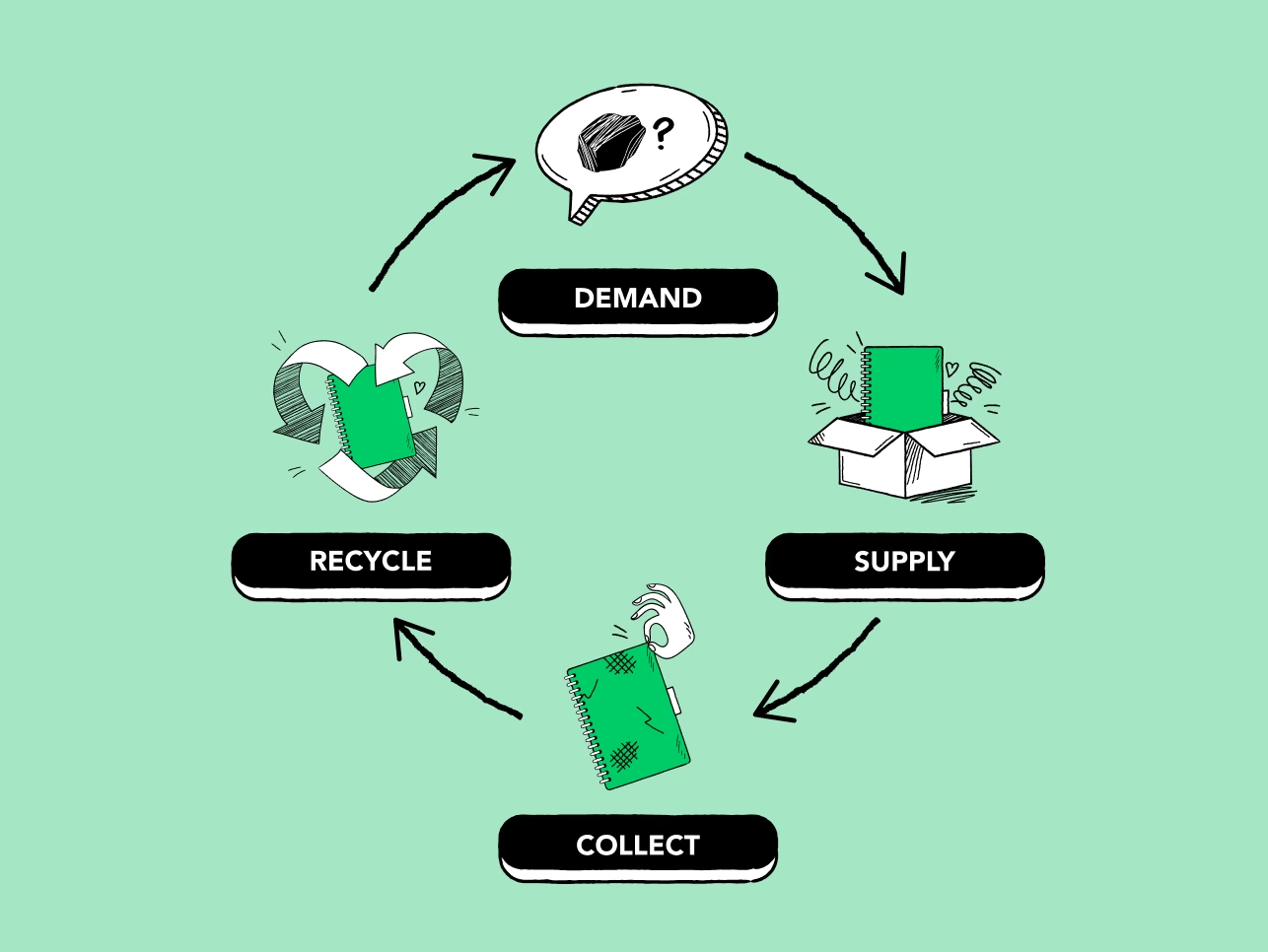
Why does this matter beyond your single notebook? Because volume is the key that unlocks everything. Once we collect enough material, a real stone paper recycling loop becomes viable: old MOYUs as raw material for new stone paper products. The factory side is ready and certified. The material is willing. We just need the stones to come home.
The biggest win happens before recycling
Here is what gets lost in the recycling debate: recycling only ever works on waste that already exists. It is the last line of defence, not the first.
Move one step up the R-ladder, to reduce and reuse, and you attack the problem at the source. In our own impact models we deliberately assume a MOYU is used for 15 cycles before it is damaged enough to retire, even though the stone paper itself lasts far longer. At 15 cycles, one notebook does the work of about 15 single-use ones. That is roughly 93% fewer notebooks produced, collected, transported and thrown away. We do not recycle a stack of notebooks more efficiently. We mostly never create the stack. The same logic applies to our Stonepacker shipping box, modelled at 15 reuses to replace single-use cardboard.
That is the real prize, and it compounds. Less material in the system means less to collect, fewer trucks, less sorting, and less lost as sludge at the mill. And the small amount that does eventually reach end of life is a clean, single-stream product rather than a contaminated mix. Prevention does not just beat recycling on paper. It makes the recycling that remains easier too. That is exactly why the waste hierarchy, the Ladder van Lansink, puts prevention and reuse above recycling in the first place.
Think in systems, not in products
Here is the part I find genuinely hopeful, and it is a very Dutch story.
The Netherlands did not become Europe's paper recycling champion by accident. We built it: 150 years of collection culture, the oud-papier-acties of sports clubs and schools, a national system of producer responsibility, agreements between PRN and every municipality [1][13]. None of that infrastructure existed before we decided paper was too valuable to burn.
The same playbook applies now, one level up the R-ladder. First reduce and reuse: use paper and packaging far more often before anything becomes waste. That is exactly what an erasable stone paper notebook does, replacing hundreds of single-use pages with one reusable surface. Then, when a product truly reaches end of life, recover the materials properly.
Every transition looks impossible right until the volume arrives. Dutch paper recycling proved it. We intend to prove it again with stone.
The full environmental comparison, from raw material to end of life, is documented in our Life Cycle Assessment. We publish it because claims are cheap and data is not: read the MOYU LCA here.
FAQ
Is paper recycling bad? No. Recycling paper is clearly better than producing virgin paper, and the Netherlands does it better than anyone in Europe. But the quoted rates measure collection rather than actual material recovery, fibre survives on average only 4 loops [7], and the process itself still consumes water and energy. Reuse beats recycling, which is why the waste hierarchy (the R-ladder) puts it higher.
How much waste does a reusable notebook actually save? In our impact models we assume a conservative 15 reuse cycles, even though stone paper lasts far longer. At 15 cycles one MOYU replaces about 15 single-use notebooks, roughly 93% fewer notebooks produced, collected and discarded. The biggest environmental gain is not better recycling, it is never creating the waste in the first place.
How much plastic is in a stone paper notebook? About 20% of its weight. For a 250 gram A5 notebook that is 50 grams of HDPE, comparable to roughly 6 plastic shopping bags [10]. Spread over years of reuse, that is about one bag's worth of plastic per year.
Can stone paper be recycled? The materials, calcium carbonate and HDPE, are both well suited for recycling. HDPE can be recycled around 10 times [11] and calcium carbonate is a standard filler in recycled plastics [12]. A dedicated stone paper stream does not exist yet due to low volumes, which is why we run our own return program.
Can I put my old MOYU in the PMD or oud papier bin? No. Dutch PMD collection is for packaging only, and stone paper does not belong with oud papier either. Send it back to us instead: we pay the shipping and you get a discount on your next notebook. That way the material stays in the loop and helps us build the recycling system of the future.
Where can I find the environmental data? In our Life Cycle Assessment, which covers the full life of a MOYU notebook from raw material to end of life.
Ready to write, wipe and rewrite instead of use and throw away? Discover our erasable stone paper notebooks and join us in building the loop.
___
References
[1] Stichting Papier Recycling Nederland (PRN), monitoring 2024: 81% recycling of non-packaging paper and cardboard, prn.nl/prn-en-het-prn-systeem/rapportage/ and prn.nl/papierrecycling/
[2] Papier & Karton, "Nederland blijft koploper papierrecycling met hoge percentages" (PRN 81%, Verpact 89%, EU average 75.1%, note on hygiene paper), papierenkarton.nl/actueel/nederland-blijft-koploper-papierrecycling-met-hoge-percentages/
[3] Cepi, Key Statistics 2023, European Pulp & Paper Industry, recycling rate definition and note on the 2023 rate, cepi.org/wp-content/uploads/2024/09/Key-Statistics-2023-FINAL-2.pdf
[4] Printmedianieuws, "Nederland koploper papierrecycling, verfijning nodig", on export of Dutch oud papier to Germany and Eastern Europe, printmedianieuws.nl/2025/10/nederland-koploper-papierrecycling-verfijning-nodig/
[5] Kinnarinen et al., Resources, Conservation and Recycling: yield loss in recycled paper production up to 25%, sciencedirect.com/science/article/abs/pii/S0921344913000207; see also "Recovering fibers from fine-prescreening reject at deinking mills" (yield as low as 75%)
[6] Pro Carton / TU Graz (2021), laboratory study on fibre recyclability of up to 25 cycles under ideal conditions
[7] Cepi, Circular Economy: "In Europe, during 2024, every fibre completed on average 4 cycles of recycling and use", sustainability.cepi.org/policy-blocks/circular-economy/
[8] Research commissioned by the German Federal Environment Agency (Umweltbundesamt), as reported by MM Board & Paper: recycled paper production saves 78% water, 68% energy and 15% CO2 versus the virgin market mix, spnews.com/fibres-are-too-good-to-use-just-once/
[9] Stone paper composition and plastic code 2 classification, en.wikipedia.org/wiki/Stone_paper
[10] UK Environment Agency, "Life cycle assessment of supermarket carrier bags" (report SC030148), conventional HDPE carrier bag weight of 8.12 grams, assets.publishing.service.gov.uk/media/5a7bff74ed915d01ba1ca7c7/scho0711buan-e-e.pdf
[11] ESE World B.V. / Plastics Today, "HDPE Plastic Can Be Recycled Multiple Times, Study Shows", plasticstoday.com/packaging/scientific-tests-prove-hdpe-can-be-recycled-at-least-10-times
[12] Pebble Printing Group, Stone Paper FAQ, on calcium carbonate as an additive in plastics recycling, pebbleprinting.com/stone-paper-faq/
[13] Janssen/Pers, "Nederland loopt voorop in papierrecycling", on the PRN system of producer responsibility, janssenpers.nl/2025/12/11/nederland-loopt-voorop-in-papierrecycling/